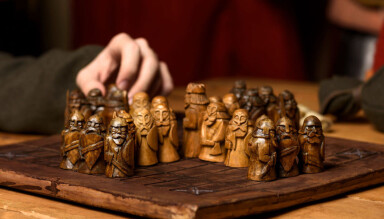
Vikingernes brætspil, hnefatafl, online.
The ancient Viking board game, Hnefatafl, online.
If you see any advertisements here for money games on the net, fast loans, get-rich-quick schemes or stock exchange, please report the link to
.
11x11
9x9
Vælg spil, klik på et af brætterne.
Choose game, click on one of the boards.
Wählen Sie Spiel, klicken Sie auf einen der Bretten.
Choisissez le jeu, cliquez sur un des plateaus.
Выберите игру, нажмите на одну из досок.
Hnefatafl-spillet er programmeret i Java, som normalt fungerer i alle browsere. Hvis browseren (fx. Explorer 7) ikke kan vise Java-programmer, kan Java hentes hos Sun i http://www.java.com/
The Hnefatafl-game is programmed in Java, which normally works in any browser. If the browser (fx. Explorer 7) cannot run Java-programs, Java can be downloaded from Sun at http://www.java.com/
Kommentarer til spillereglerne. Comments on the rules.
"Kongen omringes fra 2 sider": Når man har fået nogen øvelse i at spille hnefatafl, vil man se, at spillereglerne, som museerne (i Danmark, Norge og Sverige) har rekonstrueret, har en god balance, hvor begge sider har en fair chance for at vinde.
Startopstilling: på 11x11-brættet kan man vælge startopstilling 1 eller 2. Museerne angiver startopstillingen 1 i deres folder, som følger med spillet. Opstilling 1 har den egenskab, at hvis sort begynder, kan sort blokere spillet ved i de første fire træk at besætte felterne B2, B10, J2 og J10. Derefter i de næste otte træk besætte felterne A3, C1, A9, C11, I1, K3, I11 og K9, hvorefter brættets fire hjørnefelter er spærret af. Herefter har hvid tabt.
Dette undgås ved at lade hvid flytte først. Problemet findes ikke på 9x9-brættet eller på 11x11 startopstilling 2.
Varianten "Kongen omringes fra 4 sider": Hvis kongen altid skal omringes fra fire sider, vinder kongesiden i praksis hver gang. For at få balance i spillet igen må kongen svækkes med særlige regler, som at kongen ikke kan deltage i at slå andre brikker, ikke kan bevæge sig mere end tre felter ad gangen etc. Men det er vel ikke særlig sandsynligt for et oldtidsspil, at kongen er svagere end sine mænd og endda er ubevæbnet.
Optegnelser om, at kongen skal omringes fra alle sider, at han er svagere end andre brikker og lignende, kan tænkes at være en påvirkning fra skak, som eksisterede side om side med hnefatafl i 800 år. Der findes endda optegnelser fra middelalderen om, at modstanderen skal advares, før kongen slåes, lige som man i skak erklærer "skak!". Det kan være, en sådan ridderlighed passer til skak og til middelalderen, men oldtidens folk har vel haft svært ved at forestille sig en vikinge- eller jernalderkriger, der råber "Pas på!", før han angriber.
The rules applied for the variant, where the king is captured from 2 sides (except in the centre) are given with the version sold from the Danish museums. These rules tend to be used in Scandinavia.
The rules applied for the variant, where the king must always be surrounded on 4 sides are found for instance at Regia Anglorum. Possibly these rules originate from a chain of misunderstandings and translation errors in the Anglo-American world (see the article below by John C. Ashton) and tend to be used outside Scandinavia.
Comments on the game rules.
"Surround king from 2 sides": When you get some experience in playing hnefatafl, you will see that the game rules reconstructed by the museums (in Denmark, Norway and Sweden) are well balanced, and both sides have a fair chance of winning.
Initial ordering: on the 11x11 board you may choose initial ordering 1 or 2. The museums state the initial ordering 1 in their folder, which comes with the game. Ordering 1 has the characteristic, that if black begins, black can block the game by occupying the squares B2, B10, J2 and J10 in the first four moves. Then in the next eight moves occupying the squares A3, C1, A9, C11, I1, K3, I11 and K9, after which the four corner squares of the board are blocked up. After this white has lost.
This is avoided by letting white move first. This problem is not found with the 9x9 board or the 11x11 initial ordering 2.
The variant "Surround king from 4 sides": If the king must always be surrounded from 4 sides, the king will in practice always win. To regain balance in the game, special rules must weaken the king, like the king cannot participate in the capture of pieces, cannot move more than three squares at a time etc. But it surely is not very likely in a prehistoric game, that the king is weaker than his men and unarmed at that.
Notes about the king to be surrounded from all sides, the king being weaker than other pieces and the like, might show an influence from chess, which existed side by side with hnefatafl for 800 years. There are even notes from the Middle Ages, which state that the opponent must be warned before capturing the king, just as you give check in chess. Even if such chivalry might suit chess and the Middle Ages, people in prehistoric times must surely have found it hard to imagine a viking or Iron Age warrior, who shouts "Watch out!" before he attacks.
Links.
Læs mere om hnefatafl her.
Hnefatafl kendes også under navnene nefatavl, hnefatavl, hnefatafel og tablut (en nær efterkommer af oldtidens hnefatafl).
Links to various information about the Viking board game Hnefatafl:
NB. Notice that the Hnefatafl rules described by several sites outside Scandinavia are not in agreement with the rules reconstructed by Scandinavian museums.
John C. Ashton in USA did an interesting analysis directly from one of the historic sources, the Latin diary of Carl von Linné from his excursion to Lapland in Sweden, 1732, where Linné found and described the Sami board game called Tablut, a descendant of the at that time lost Viking game Hnefatafl. Ashton suspected the Hnefatafl game rules in Anglo-American countries, fx. stating that the king must be captured always from 4 sides, to be erroneous due to a chain of translation errors and misunderstandings. Therefore Ashton started over again with a fresh translation of the Latin text of Linné.
The research article and findings of John C. Ashton were published in the journal Board Game Studies, read the article, Linnaeus' Game of Tablut and its Relationship to the Ancient Viking Game Hnefatafl, here.
On the Viking longship Sea Stallion:
The Sea Stallion is an accurate copy of a 30 metres Viking longship with 60 oars and 65 men. In 2007 the ship sailed from Roskilde in Denmark to Dublin in Ireland, and in 2008 the ship returned to Roskilde. The crew on board came from Denmark, Norway, Sweden, Finland, Ireland, UK, Germany, Netherlands, USA, Canada and New Zealand.