Copyright © 1998-2026 Aage Nielsen. All rights reserved.

Around 2013, Mikkel Berg-Nordlie, Norway, wrote this article about Dablo and stated the following rules for Sørsamisk Dablo:

In the same article around 2013, Mikkel Berg-Nordlie writes about Cuhkka, Sjøsamisk Dablo.
The described Cuhkka game is identical to Alquerque from the 9th century, which is considered to be the parent of draughts.
It is identical, with the single exception that Alquerque has mandatory capture, while the described Cuhkka rules do not.
The absence of mandatory capture means that, while Alquerque works well, Cuhkka tends to produce repetitions and unfinished games.
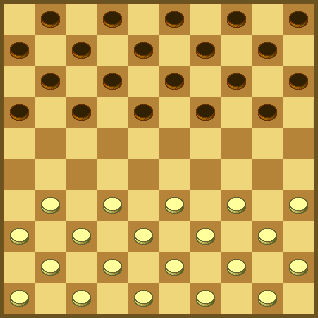
In October 2022 we were fortunate to meet the Frisian double World Champion in Frisian Draughts, Marten Walinga, who visited Denmark to promote Frisian Draughts.
Walinga demonstrated Frisian Draughts and the simpler version Frysk, and explained the history of the draughts family of games. In the Middle Ages the old games were often spread along the sea trade routes. The original draughts games were played on boards with lines in all directions, such as the Daabloe and Cuhkka boards. It was only sometime in the 1500s in Spain that the game was modified to be played on an ordinary chessboard, and this was then called "the new draughts". Later, everyone forgot about the word "new" and simply called this modification draughts.
Here is an overview of the rules of Frisian Draughts:
It also became clear that the Saami game Daabloe is very closely related to Frisian Draughts. Daabloe is simply played on an authentic draughts board of the kind used before draughts was transferred to the chessboard in the 1500s.
Here again, Frisian Draughts has mandatory capture, which is not mentioned in historical sources about Daabloe.
Walinga demonstrated the most spectacular and beautiful move patterns in Frisian Draughts, which were only possible because of the mandatory capture rule.
To test Daabloe with this remarkable feature, the version "Frisian Dablo0", with mandatory capture, was added in October 2022.
NB. Brave-Frog from Ukraine discovered that with this starting position and these rules, the king can always be captured within the first three moves.
To avoid this, the king and the front pawn are exchanged in the starting position.