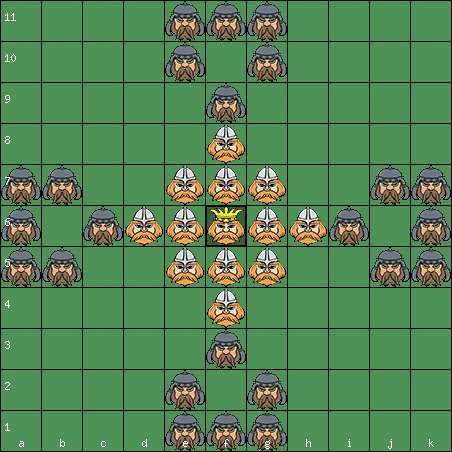
1. Two players may participate. One player controls the king's side, with a king and his defenders, while the other controls the attackers. There are 24 attackers and 12 defenders.
2. The game is played on a board with 11x11 squares and with initial set-up as shown:
3. The attackers' side moves first, and the game then proceeds by alternate moves.
All pieces move any number of vacant squares along a row or a column, like a rook in chess.
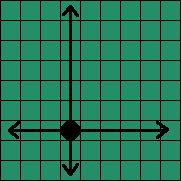
Moving a piece.
4. All pieces are captured if they are sandwiched between two enemy pieces along a column or a row. The two enemy pieces must be on the squares directly above and below, or directly to the left and right of, the attacked piece. The king participates in capturing like all other pieces.
A piece is only captured if the trap is closed by the opponent's move, so it is allowed to move in between two enemy pieces.
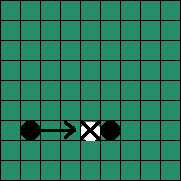
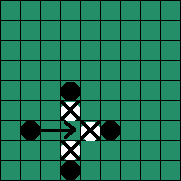
Capture of pieces.
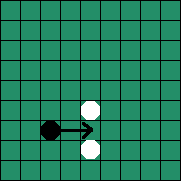
The piece is not captured.
5. The objective for the king's side is to move the king to any edge square. In that case, the king has escaped and his side wins.
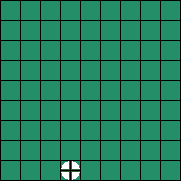
The king's side wins.
6. The attackers win if they can capture the king before he escapes. The king is captured like all other pieces.
7. If the attackers surround the king and all remaining defenders with an unbroken ring, they win, as they have prevented the king from escaping.
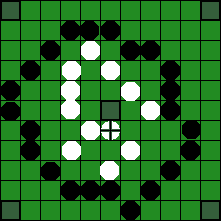
The attackers win by encircling all defenders.
The text is modified from Sten Helmfrid's text on the Skalk variant.